The Cambodia Daily
March 9, 2026
A Cambodian civil society watchdog has expressed concern about the living conditions of more than 200 displaced families who have been relocated by the government to temporary shelters in a remote area.
Men Nath, president of the Cambodia Watchdog Council, said the site selected for the settlement appears unsuitable for long-term living, describing it as an isolated location lacking basic services.
Speaking to The Cambodia Daily on Monday, Men Nath said the area where the temporary shelters have been built has no markets, schools, hospitals, or other public services. He said the situation raises concerns that the displaced families may effectively have been left without the infrastructure needed to rebuild their lives.
According to Men Nath, it is unclear how long the families will be able to remain there. He noted that the location offers few opportunities for residents to earn a living, which could eventually force them to leave and seek work elsewhere. He compared the situation to that of residents previously relocated to Run Ta Ek [in Siem Reap province], where some people later moved away due to limited economic prospects.
He added that the government should conduct a more comprehensive assessment of the relocation sites. With the ongoing border dispute with Thailand unresolved, it remains uncertain when Cambodia might regain control of the affected areas and allow displaced residents to return to their original homes.
Men Nath said there are three mechanisms the government could use to address the border issue with Thailand. These include action on the ground to prevent territorial encroachment, stronger diplomatic engagement on the international stage, and pursuing a legal case through an international court. He argued that the government has so far relied mainly on diplomatic channels, and that those efforts have not yet been sufficiently broad.
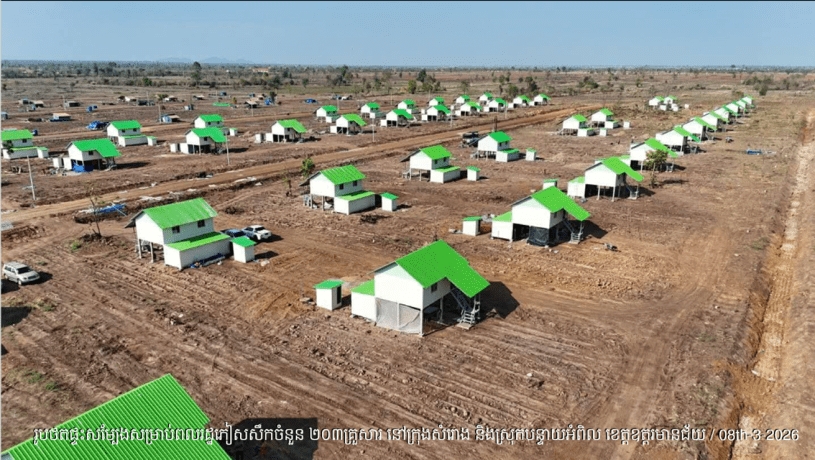
On March 8, 2026, photographs circulating widely on Facebook showed rows of newly built temporary homes for 203 displaced families in Samraong city and Banteay Ampil district of Oddar Meanchey province.
The images showed identical houses arranged in a remote open area that is not yet developed as a residential community and lacks infrastructure. Many of the displaced families themselves remain uncertain whether they will be able to live there in the long term.
Earlier, on January 26, 2026, Cambodia’s Ministry of Land Management, Urban Planning and Construction held a meeting to select sites for temporary housing for residents who lost their homes along the border after what authorities say was an illegal incursion by Thai troops.
Officials said five provinces have been designated for the construction of temporary housing for displaced families: Battambang, Banteay Meanchey, Pursat, Oddar Meanchey, and Preah Vihear.
Cambodian Prime Minister Hun Manet told the international news outlet Fox News on February 19 that Thai troops had surrounded several Cambodian villages with barbed wire and shipping containers, preventing around 80,000 civilians from returning to their homes.
The Cambodia Daily said it had not yet been able to reach government spokesperson Pen Bona for comment on the construction of the temporary shelters by the time of publication.

